Authentic hope for answers

We need – indeed, as a human race, have always needed – valid answers to the great existential questions we all ask sometimes. Questions like, “Where did we come from?” “Why are we here?” “Where are we going?” “How to know right from wrong?” “Is there a God?” “What happens to us when we die?” “Is there reliable truth to answer these questions?” “How can we know?”

This blog is entitled “Authentic hope for answers”. This expresses in four words my conviction not only that there are universal answers to these questions, but that these answers are available to the sincere seeker. Furthermore, we all, both as individuals and as a society desperately need real answers to these basic and vital questions. Why? Because without valid answers we just press on further into hopelessness, meaninglessness and despair.

Our angst comes from not having yet found the true answers to these questions. Great minds down the ages, from philosophers to sages to scientists have struggled more or less valiantly with these issues, but finding the answer has proved elusive. In the absence of answers, what happens? People who don’t know what life is all about, who have no idea – and maybe little thought – about the meaning of their existence, become deeply confused, uncertain, destabilised. This can lead to one of two outcomes. The more “positive” of these is to conclude that pleasure is the only thing that counts – pleasure at whatever cost. Pleasure in enjoying life to the full, seeking a maximum of joys in the hopeless quest for ideal happiness: yet it still remains tantalisingly out of reach. The less happy outcome of finding no answers is to drift into psychological despair, to face up to the miserable meaninglessness of existence and to give up on life. Both of these outcomes contribute to the consumption of alcohol and drugs – which compound the basic inner problems with outer, physical suffering too. Some in the category of the second outcome conclude that life is not worth living and end it all in utter tragedy.

To all such sufferers I would cry out: stop! Listen! There are answers! Hope for answers need not be disappointed. There is truth – and the one who seeks still can find.

Clive Every-Clayton

Featured post

Some inescapable basics

Our desire for authentic answers shows that we are rational thinkers, curious to understand our world and ourselves (and others). We are endowed with a mind which in some undecipherable way works in and through our brain. Our brain is the most complicated thing known to mankind; we all have one, and its performance capacity is amazing. Where did it come from? How is the mind involved in the atomic movements within the brain? These questions are beyond human understanding; they are the very mystery of human life.

Atheistic scientific materialism would have us believe that all our personal thinking is nothing other than the complex movements of the brain – that ultimately, we do not have personal freedom to think and understand truth because we are simply part of the cosmic machine. But we find that explanation unacceptable; it reduces us to robots with no freedom of choice, no real love, and ultimately no meaning either. The philosophy of scientific materialism does not provide any serious authentic answers to our very real hunger for finding truth about ourselves. Such “answers” undermine any hope for truth about our human reality. That is why societies dominated by that philosophy are struggling with mental health issues, because without some acceptable answers our human existence is bound to suffer both individually and in our social sphere. Bereft of wise moral absolutes, without meaning or purpose to their human existence, people don’t know where they are going and have no uplifting hope for their future. 

This is why people are more seriously reconsidering the Christian framework in which our many existential questions do find answers that are both reasonable and fulfilling. There is authentic hope for answers in studying the Bible: if it is the inspired communication of our Creator God, it should provide the answers our hearts long for. Does it? Well, yes, it does! This is what Christians realise, and though Christian believers do not necessarily understand all the answers, their source-book, the Bible, furnishes light enough to lead them out of the darkness of uncertainty and insecurity, into a life – when one believes in Jesus as Lord and Savour – that is the most fulfilling life possible. Jesus said, “I have come that they might have life, and have it abundantly”. He declared “I am the way, the truth, and the life”; and again, “whoever believes in me has eternal life” (John 10.10, 14.6, 3.36). He was so perfect in life that when he was killed, he came back to life. He, of all people who have ever lived, is totally worth following, and untold millions throughout the world have found that he does indeed bring into our lives a spiritual dynamic that makes sense and provides deep joy.

As the scientific materialist worldview has no absolute source of wisdom for moral questions, the typical outcome is to adopt a hedonistic outlook, living for personal pleasure. This is just selfishness by another name, and though it seems promising at first, its promises turn out to be illusions of a happiness that is never fulfilled, always wanting more, and never at peace. It takes the wisdom of the Bible to teach us that true happiness, blessedness, and fulfilment come not by giving free rein to our lusts, but by denying our evil tendencies and committing to follow that which is good. And who defines the true good? Well, only God: he alone is perfectly good, and wants to lead us into the true, deep, and meaningful happiness that comes from the real good life, a life that the Bible calls blessed.

Clive Every-Clayton

Is faith too simplistic?

Some may protest that the Christian message is too easy: is all you have to do to have access to eternal heaven, to believe in Jesus? Is that what Jesus meant when he said, “God so loved the world that he gave his only Son, that whoever believes in him should not perish but have eternal life”? Just believe in Jesus – is that all?

While that appears quite simple, you need to think a bit more: you can’t just decide to believe in something without taking it seriously as true. In fact, faith means trusting in the truth of what is said. And if we consider a speaker to be not serious and trust-worthy we just can’t believe all he says.

On the other hand, there are those who think that becoming a Christian involves a whole lengthy study of all the aspects of deep theology which, like the principles of Buddhism, require considerable effort to really grasp. Of course, when we deal with God almighty we may expect there are issues that cannot easily be understood. Then some would say, “Don’t bother trying to understand – just believe”. That option, however, errs on the side of the simplistic and misunderstands what’s involved in truly believing. 

What we need, for a clear and real kind of faith, is to find the happy medium between the simplistic on the one hand, and the hyper-complicated on the other. What’s necessary in order to have faith that saves the soul? What exactly is that sincere faith in Christ that leads to a real conversion to Christ?

Essentially three things:

  1. To know the basic facts of Jesus’ life, death, and resurrection.
  2. To realise that these facts call for a personal response
  3. To make that response in a commitment of repentance and trust in Christ which is formulated in a prayer.

Let’s think those three things through.

First, the Bible itself says, “How are people to believe in him of whom they have not heard?” (Romans 10.14). Obviously, in order to believe and trust in Christ, we must know who he is and what he has said and done. That’s why the Gospels were written. John ends his account of Jesus’ life saying, “Now Jesus did many other signs in the presence of his disciples, which are not written in this book, but these are written so that you may believe that Jesus is the Christ, the Son of God, and that by believing you might have life in his name” (John 20.30-31). Becoming familiar with the Gospel records of Jesus’ life is therefore basic to believing in him. Such biblical information does not necessarily lead to faith, but it is essential to know the Gospel facts about who he was, what he said and particularly, that he died to save us. 

Secondly, Jesus’ teaching calls us to “come to him” (Matthew 11.28), to “trust in him” (John 14.1), “to follow him” (Matthew 4.19), and to “love and obey him” (John 14.21,23). He consistently teaches that his followers must commit to living in a real relationship with him, their risen Lord and Master. He insists there needs to be a turning from all evil and a decision to live a new life following him.

Thirdly therefore, faith in Jesus shows itself by turning in prayer to Jesus, asking him to come into our lives as our own personal Lord and Saviour, promising to put away all sins that he disapproves of, and to live the rest of our lives as his faithful followers.

If you haven’t done that yet, maybe now is the time. 

Clive Every-Clayton

God is not just a theory

Sometimes believers and apologists for the Christian faith give the impression that you can argue others into having faith. They compare the poor arguments of scientific atheism with their proposing the Christian faith and want to show that the Christian “theory” is more plausible than any other.

While there is truth in this, it may have the result of leading the unbeliever to conclude that Christianity is just another theory, which sooner or later will be shown to fall short of what is required. In other words, the whole discussion remains at the level of argument and speculation. But this is not the way Christianity truly functions, because it is not just a philosophical position, setting forth the theoretical existence of God as its basis. No – Christianity has as its unique basis in the historical life, teachings, death and resurrection of the extraordinary historical person, Jesus, the Christ, i.e. the Messiah, the incarnate Son of God.

The ministry of Jesus was totally unique in the history of the world. The work of “evangelism” that Christians are committed to do consists not of arguing for the truth of the Christian faith but of announcing the historic facts of Jesus’ life and ministry. There is profound truth in the expression: “Christianity is Christ”. The life and teaching of Jesus Christ is a phenomenon of world history which calls for assessment. Everyone should know that his life and ministry occurred – indeed, two thousand years ago exactly his feet were walking on our planet. 

When you examine other religions, you find that they may make reference to historic events, but their teachings are ultimately man-made propositions about God (or the gods) and what the divinity demands. They offer supposed rewards in the next life, particularly for those who obey their moral requirements. They claim that these commandments are specified by their gods, and that those who obey them will enter the equivalent of heaven. That positive final destination is held out to those who faithfully obey the laws laid down by that religion.

It appears there is a sensitivity in the human soul that responds to such hope-giving teaching; so everywhere there are devout people who do their best to follow the path set out, hoping that their recompense will be great beyond death. However, those who made those religious promises did so before they died, and were ultimately as ignorant of the after-life as all the rest of us. Their promises were unfounded.

Here, Jesus is in a class by himself, for after his death by crucifixion, he rose from the dead and continued to teach for another forty days before returning to heaven where he had come from. Jesus is also unique in his teaching that he had come from God in heaven in the first place. And on two occasions, the Gospels relate, God spoke out audibly from heaven affirming: “This is my beloved Son, with whom I am well pleased; listen to him” (Matthew 3.17, 17.5).

Clive Every-Clayton

After death – what?

Imagine asking an auditorium of 1,000 people to say where they expect to spend eternity – heaven or hell. (Of course, a number would refuse either option, preferring to think they will be annihilated). But I would imagine, out of the 1,000, maybe one person would admit they deserved hell. In other words, basically no-one ever seriously believes they will end up in hell. How about you?

Most religions have beliefs about life after death; it seems our human psyche requires some sense of justice being done in an ultimate divine assessment of our lives. The problem, of course, is to get anywhere further than a vague unfounded hope.

Some think that the idea of hell comes from the Old Testament with its God of fiery fury and righteous wrath. Interestingly, the Old Testament has only sparse allusions to anything like hell; for the most part its notion of the afterlife is hazy. Daniel 12.2 refers to the end-time possibilities of “everlasting life” and “shame and everlasting contempt”.

It was Jesus who spoke a lot about “eternal life” and the alternative that he called hell. He warns of being “cast into hell” (Mark 9.47), and in the Sermon on the Mount of those “in danger of hell fire” (Matthew 5.22). He describes it as a place of torment – “a fiery furnace – in that place there will be weeping and gnashing of teeth” (Matthew 13.42). The lost, he says, “will go away into eternal punishment” (Matthew 25.46). While some of the dead will be received into God’s presence along with Abraham the father of the faithful, Jesus describes others as being “in torment”, and “in anguish” (Luke 16.23-25).

This is so often overlooked because we consider Jesus as being essentially kind and ready to forgive: but for Jesus it was an act of kindness to warn us that there is a hell to avoid and yet an eternal life that can be ours after death.

How can we know truth in this hidden domain? God only knows, ultimately. But Jesus affirmed that he, the incarnation of God, had “come down from heaven” to “bear witness to the truth” and to say “whatever the Father told him to say” (John 6.38, 18.36, 12.49-50). 

Ultimately God alone knows what will happen to us after death. But in Jesus, he came down to tell us. More, he came to warn us – for hell is not merely for those guilty of committing the most horrific crimes. Hell will be the righteous punishment meted out to all sinners, “according to their works” (Matthew 16.27). And since the Bible clearly teaches that we have “all sinned” (Romans 3.23), it invites us all to be saved from hell by finding forgiveness and receiving the gift of eternal life, which Jesus promised to those who repent and believe in him.

Jesus came out of heaven not just to warn us of hell: he gave his life on the cross to make salvation possible. On that basis he promises eternal life to those who entrust themselves to him as Lord and Saviour. “To him all the prophets give witness, that everyone who believes in him receives forgiveness of sins through his name” (Acts 10.43). This is how to avoid hell. Jesus said, “Whoever hears my word and believes him who sent me has eternal life; he does not come into condemnation but is passed from death to life” (John 5.24). “God so loved the world that he gave his only Son, so that whoever believes in him should not perish [in hell] but have eternal life” (John 3.16).

Clive Every-Clayton

Ultimate reality

What is finally and absolutely real and true? Philosophers and wise men throughout history have grappled with the “impossible” task of grasping ultimate reality. It appears impossible because no great thinker has ever been able to come up with the complete answer to the enigma of what is really real. After centuries of deep reflexion no-one has brought us the final answer. Renowned apologist Os Guinness gives his considered judgment: “There is no completeness, finality or scientific level of proof in any philosophical argument, and those who have claimed to find one have always fallen on their faces. All philosophical claims can be countered with refutation. All positions can be ridiculed and rejected”.

This sounds a pretty damning assessment, but it is true: history has proved it. All philosophical propositions, and also all scientific understanding, are ultimately based on a faith-assumption. Every foundational proposal is established first and foremost on a postulate taken on faith; why then should the Christian position be excluded because it requires faith? What makes the difference between the Christian worldview and that of all philosophy is that it starts out from a “given” set forth as a word revealed by the all-knowing God. Admittedly this requires faith; but it differs from all the other faith systems proposed by human thinkers in that it postulates an omniscient God, actually there and able to communicate, as the source of the fundamental truths it sets forth.

Let’s put it this way: if there is (as science tends to lead us to believe) an almighty super-intelligent Creator at the origin of this amazingly structured universe, it is well conceivable that he may have communicated some of the truth he knows to us who can receive it. In “Return of the God Hypothesis”, scientist Stephen Meyer sets out three scientific discoveries: the “Big Bang”, necessitating a Beginner; the extraordinary and mind-boggling fine-tuning observable in the universe, indicating an amazing mathematical Intelligence; and the mysterious language of DNA that must require an infinite Mind. Consideration of these scientific facts leads Meyer to conclude that the hypothesis of a Creator God has amazing and unique explicatory power and is therefore a strong contender for foundational truth about reality.

But to our great surprise, at the beginning of the New Testament Gospel of John, we have a statement that in all simplicity reveals Ultimate Reality: “In the beginning was the Word” (John 1.1). Not, in the beginning God created something, or did something; that was already stated in Genesis 1.1. Rather this refers to what was, right at the beginning. John goes on to add, “The word was God”. He is the ultimate reality. 

Is this a mere supposition? John continues: “The Word was made flesh and dwelt among us; and we have seen his glory, the glory of the one and only God, full of grace and truth”. Here he states that the Word – God – became incarnate, uniquely, in Jesus. And not only is this a theory: he and the other disciples saw his glory as uniquely God and man, as he walked the roads of Palestine 2,000 years ago, healing the sick , raising the dead, teaching the crowds, giving his life on the cross, and rising triumphant over death three days later to return into the glory that he left in coming into the world. 

John concludes: “We know that the Son of God has come and has given us understanding so that we may know him who is true” (1 John 5.19).

Ultimate reality has come down to us; we do well to pay attention!

Clive Every-Clayton

Who says evil is good?

We all know there is a difference between good and evil; the problem is that while there is a general consensus as to what is good and evil, there are some things that are considered good by some people, whereas others see those things as evil. Hence the question: who can tell what good really is? Who can define those things that are evil?

Let’s imagine a person who holds that burglary is actually a good thing to do; logically, therefore, everyone should do it – since if it is good, it should apply to all. If that person’s moral philosophy was held universally, burglaries would not only be commonplace they would incur no arrest or imprisonment. But everyone would be up in arms when someone stole something from them! Such a moral philosophy that flies in the face of human normality has to be wrong.

What about the person who believes it is good for people to sleep around with various sexual partners? If this is universalised as a wise moral philosophy, shared by all, you can imagine the kind of social chaos that would result. Is there someone who could impose wisdom in place of such a disaster?

These scenarios concern people who think they have the ability to define good and evil. While many make their own choices in moral questions, few would want their particular preference to be made into a universal law. Humans cannot impose their invented moral absolutes universally. People wouldn’t stand for it – though in some totalitarian states such abominable practices have occurred; and good people shudder.

While we all have a sense of right and wrong, we must acknowledge the limits of our wisdom when it comes to specifying what is good and what is evil for everyone. The prophet Isaiah calls out a certain perversity: “Woe unto them that call evil good, and good evil” (Isaiah 5.20). Woe upon such, indeed, for if that moral philosophy were to obtain, all hell would be let loose!

Friederich Nietzsche falls under that “woe”. He discarded God and any divine moral code and wiped out the moral order that obtained under Christianity; but he fully realised the desperate damage that would result – and which indeed has brought about the moral confusion of our secular society.

The fact is that while we have moral sensitivity and conscience, we do not have totally right views of good and evil. We need the light that comes from an absolutely good source. This is a service that our Creator has done for us: he alone is “holy, holy, holy”; his wisdom alone is able to provide true goodness to enlighten the conscience with which he has endowed us. All other potential helpers are poisoned with evil in our hearts, so unaided, we can never get it right. The Ten Commandments are God’s basic ground-rules, but there is a lot more we need to know. So God sent his holy Son to teach us the subtleties of true good living, and to call us to it. He it is whose call comes to us to “repent” – to rethink our ways and to alter our behaviour in the light of His will that defines good for us. Ultimately only God can provide the moral absolutes we need.

The wondrous thing about the Christian revelation is not only that in it God provides those truly good moral absolutes, but also, by God’s loving grace, it introduces us to a heavenly Father who forgives our many misdeeds and makes us anew as we are “born again”.

Clive Every-Clayton

The thoughts of Blaise Pascal

The published thoughts of this French scientist, mathematician, wise Christian thinker, make for fascinating reading. Born 402 years ago he had a habit of noting down his thoughts with a view to writing a book in defence of the Christian faith, but his death came too early. However, his notes were considered so special that they have been published as his “Pensées” (thoughts). Even atheists like Friederich Nietzsche and André Comte-Sponville have expressed their appreciation of the profound wisdom of these Pensées and they have been translated into many languages and are still in print today.

Here is an example: “Man’s true nature, his true good and true virtue, and true religion are things which cannot be known separately”. Today we are perplexed about man’s “true nature”, or identity. We long to understand what is man’s “true good”, or human flourishing. Our secular society has no grounding for man’s true virtue, unable to provide absolute guidance about right and wrong. And the reason for our post-modern confusion on these issues may well be due to not having taken wise consideration of “true religion”, which for Pascal meant biblical Christianity. 

Once we come to terms with the fact that our Creator God has revealed the “true religion”, we have the key to understanding all the rest. What is “man’s true nature”? He is a reflection of the pure righteousness and goodness of God, having been at the beginning “created in the image of God”. But he no longer fulfils that high and holy calling. Rather the Bible tells us that bad human choice has corrupted our nature, so our lives no longer appropriately display the holiness of God. That is why our purpose eludes us: we have lost our true good: tainted by sin, we no longer live in unspoilt virtue. Hence we misunderstand our true nature.

What will enable us to find true human fulfilment? A return to the true religion of the Bible where our Creator reveals his plan for human life and conduct. As we revisit that divine guidance, we need also to readjust our life-style in consequence. The Bible calls us all to this conversion – turning away from all sin and committing to live according to God’s revealed wisdom. This, as Pascal saw, is the key to experiencing true human fulfilment.

When Pascal died, what was called his “memorial” was found, handwritten on paper sewn into his clothes. It was the brusque report of a powerful experience of God that he had at the age of 31. It begins, “FIRE! God of Abraham, God of Isaac, God of Jacob, not of the philosophers and scholars”. In other words, Pascal had met with the God revealed in the Bible, not with some mere philosophical supposition. He continues: “Certainty, certainty, heartfelt joy, peace. God of Jesus Christ”. This encounter overpowered him and convinced him that he was actually meeting with God. He adds, “He can only be found by the ways taught in the Gospels”, and quotes the words of Jesus’ prayer: “This is eternal life, that they may know you, the only true God, and Jesus Christ whom you have sent” (John 17.3). The “memorial” ends with a note of “Sweet and total renunciation. Total submission to Jesus Christ… Everlasting joy”.

This was such a transforming experience that he longed to teach the way of the “true religion” that he had not only studied, but experienced in this extraordinary meeting with the living God, through Christ. The “Pensées” that he wrote were the outworking of this powerful meeting with the living God.

Clive Every-Clayton

Moral absolutes?

The alternative to having moral absolutes is either total hedonism – everyone does whatever he wants, or standards imposed by dictators or politicians – the politically correct. Moral absolutes can only come from our Creator God who, logically, knows what is good and right for his created species.

Our secular Western society has followed the path of rejection of God with his moral absolutes and is trying out the other options. As time goes by, the results of these options is causing a lot of confusion, both in society and in the personal lifestyles of numerous people. The problem is that while humans can discern what is good and evil – we have that moral capacity – we are unable, without Heaven’s aid, to determine what are absolutes that apply to all people everywhere. Yet clarity here is a profound human need, for it is bound up with feelings of guilt which may or may not be authentic, and which can cause serious psychological health issues.

It seems that our bodies and consciousness are fashioned in such a way that we feel guilt when our conscience tells us we have transgressed our own personal moral code. No-one likes to feel guilty! It is an unpleasant emotion – and yet it is universal. Whatever may be our understanding of good and evil, we know when we have contravened our own moral standards. This raises the issue as to how to deal with this bad feeling. Some repress such disturbing thoughts, and press on regardless, but that leads to hardening of the heart and inability to wisely judge between right and wrong. Others are overwhelmed with self-condemnation and remorse; their self-image goes through the floor, and they suffer psychologically, unable to forgive themselves. So how to deal with guilt is a major concern for many people, as psychologists can testify.

This is especially the case with sexual misconduct, which takes many forms. If we have no clarity about moral absolutes here, we flounder in all kinds of guilt feelings with the attendant psychological pain and confusion.

This morning I read in the Bible the list of sexual sins that God prohibited in Leviticus chapters 18 and 20. It is quite an impressive and detailed list of forbidden sexual acts. Some, including homosexual acts, are described as “abominations” in God’s eyes. Others proscribe sex between close relatives. But what struck me was who was giving these absolute prescriptions. At the beginning of each chapter, it says, “The Lord spoke to Moses, saying, Speak to the children of Israel and say to them…” In other words, these were not merely human ideas coming from the prophet Moses: he was told by the Lord God, the Creator of sex (!), how this special gift of sexuality was to be properly experienced. When God uses the word “abomination”, that indicates a serious misuse of the sacred gift of sexuality.

Back in the beginning, when God made man in his own image (Genesis 1.26-28), he made them “male and female” and encouraged them to have sexual relations so as to “be fruitful and multiply”. God instituted the family by creating a wife for Adam and presenting her to him (Genesis chapter 2). These facts are the basis for justifiable moral absolutes. God, who created us in his image, serves humanity in providing such clear moral guidance that prevents our guilt if we follow his law. To depart from those guidelines, to disobey the “Maker’s instructions”, is to bring upon ourselves the terrible discomfort of real guilt before a holy God to whom one day we will have to give account.

Clive Every-Clayton

Sin can be forgiven

This perceptive word was written in the Gospels: “Who can forgive sins but God alone?” (Luke 5.21). It’s great news to know that God is in the business of forgiving sin.

This is especially the case when considering sexual sin. Most people are aware of the Ten Commandments, one of which prohibits adultery. Adultery is remarkably common, as is fornication (sex outside of marriage) and various other forms of sexual activity condemned by Jesus under the general term “sexual immorality” which he listed among various other sins (Matthew 15.19). These sins arouse a particularly deep feeling of guilt which is hard to shake off. 

The “Good News” that the Gospel of Christ brings, is that “All the prophets bear witness to Jesus, that everyone who believes in him receives forgiveness of sins through his name” (Acts 10.39). Forgiveness of sins can be received! It can be yours because of the Lord Jesus Christ: he “bore our sins in his body” on the cross, so that we sinners might be forgiven. The early Christian preachers declared: “Through this man, Jesus, forgiveness of sins is proclaimed to you, and by him everyone who believes is justified [i.e. declared legally righteous] from everything from which you could not be justified by the law of Moses” (Acts 13.38-39). God’s forgiveness clears our slate, makes us acceptable at the great Day of Judgment, and opens the way to heaven. 

This is the promise of the Word of God himself. The very first Christian proclamation, given by the apostle Peter seven weeks after Jesus had died and risen again, ends with these words: “Repent and be baptised every one of you in the name of Jesus Christ for the forgiveness of your sins, and you will receive the gift of the Holy Spirit”. To be forgiven there are three essential conditions: to repent, which means to turn away from all sin, and the Holy Spirit is given to make that possible. The second condition was mentioned in the previous verses, to “believe in the Lord Jesus”, which means to receive him as your Lord, Master, Saviour and Friend, and to become one of his followers. The third condition was to be baptised in the name of Jesus, which means to make a public stand as a Christian, committed to obey Jesus as Lord.

In other words, you can’t expect to get God’s forgiveness with your right hand while continuing to sin with your left! You have to be honest with God. Forgiveness is free – you don’t have to earn it by any special pilgrimage or fasting or deeds of mercy. You do, however, have to decide with God’s help, to change your life around, to repent and give up your sins – which is not easy, but God’s Holy Spirit will help you if you pray sincerely in Jesus’ name for God to forgive you. He will be glad to answer that prayer!

Then, however heinous may have been the sins you have on your conscience, they are all wiped away by God’s grace. God promises: “Though your sins are as scarlet, they shall be whiter than snow” (Isaiah 1.18), and “Your sins and your iniquities I will remember no more” (Hebrews 8.12). God’s forgiveness is mediated through his word of promise written in the Bible. He is a God who “forgives iniquity and transgression and sin” (Exodus 34.7). If we fulfil the conditions, he will fulfil his promise.

Maybe you will want to turn to him in prayer right now? He is right there close to you: open your heart to him.

Clive Every-Clayton

Reforming the church

Some parts of the modern-day church are called “Reformed.” One may wonder why. Should the church need reforming? May she have gone off course? Is she infallibly held in the truth or may she become corrupted? If so, what authority is competent to reform her? Is it even thinkable that anyone may be able to reform the church? The church is a global phenomenon of believers in Jesus, divided into innumerable groups, some large, some small. It is so huge that no-one can grasp the whole with a view to reforming it, not even the Pope.

So while some want a progressive or reforming Pope and others insist on a traditional Pope, there are already two dividing tendencies within the Roman Church, quite apart from the many other kinds of churches. And if one wants to “reform” the church, by what criteria might it be reformed?

The 16th century saw what came to be called “the Reformation”. The moral quality of the church and its leadership had suffered a sad decline over the previous century. Even Roman Catholic historians admit the immoral behaviour of some Popes left a lot to be desired. Their conduct was unworthy of the Lord Jesus Christ whom they professed to serve.

Apart from that moral decline, the reformers discerned theological errors that had been adopted in the church’s teaching and practice. How did they know there were errors? By a return to studying the Bible.

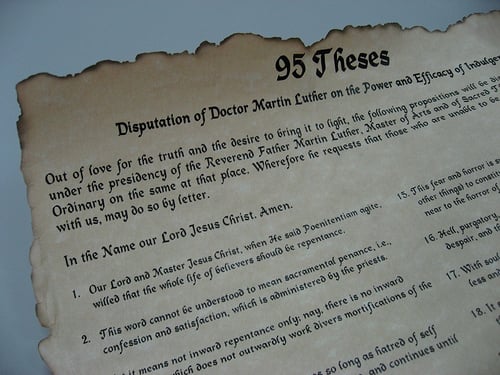
Martin Luther was a monk whose task was to teach theology. He therefore studied the Scriptures that he had to teach. As he did so, he struggled to understand some key concepts that were fundamental to the Gospel message, notably those of righteousness and justification. He had his own personal struggle to become righteous, being very conscious of his inner faults, spending a lot of time in confession. He was at the same time puzzling over St Paul’s teaching on the theme of justification, notably in the epistle to the Romans chapters 1-5.

After a lot of soul-searching and Bible study, he finally found the key that he had never grasped before: how God “justified” (i.e. declared legally just and acceptable in the judgment) those who believe in Jesus, the Saviour who died and rose again for their salvation. None of his confessors or colleagues at university had been able to share this good news with him, for they neither taught it nor understood it themselves. But there it was in the New Testament!

It was this rediscovery of the Bible’s message of “justification by faith in Christ” that led to the reformation and birthed the “reformed church”. While official church leaders condemned Luther, many were glad to receive the message of salvation by faith in Christ. They studied the Bible to find the truth of God, and by that truth they sought to reform the church’s moral laxity and its inadequate teaching on justification.

When challenged as to why they held their doctrines, their answer was simply, “Because the Bible says so.” The Bible was henceforth to be the sole authority to which Christians should absolutely adhere. In any dispute, the way to resolve it was always by a return to studying what the Bible actually says. This remains the principle of the reformed church.

Unfortunately, the temptation to allow passing philosophical trends to influence theologians has led parts of the church to drift from biblical faithfulness. Wisely did the Reformers insist that the church should be “semper reformanda” – continuously reforming itself by Holy Scripture, maintaining the purity of both its holiness and its biblical doctrine.

Clive Every-Clayton

Blog at WordPress.com.

Up ↑