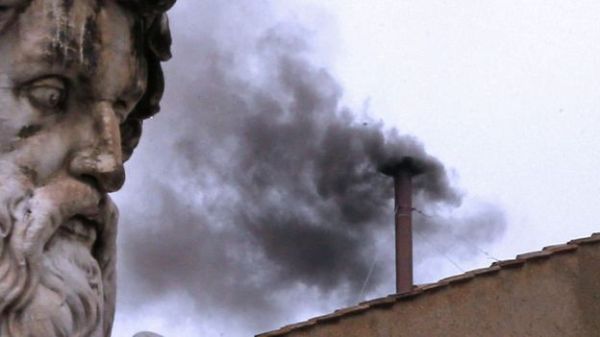
The death of Pope Francis reminds me of the time some years back when a different conclave was about to choose a new pope. I thought it would be pertinent to write an article about whether it was really Jesus’ desire that his church be governed by a “pope”. So I wrote, (in French as I was living in Belgium at the time), a full page article that I sent to La Libre Belgique, which they published the day after Cardinal Ratzinger became Pope Benedict. However, they chose for my article a title which I had not proposed at all, though my feeling was not betrayed by it: “Jesus didn’t want a Pope”.
I have several reasons for thinking that the Roman Catholic version of Christianity is not the best, and I have written a booklet (again, in French) on the differences between Catholics and Protestants. The most essential difference is the source of authority for what the church teaches.
Obviously, the teachings of Jesus are central for all Christians and they are consigned in the four biblical gospels: Matthew and John (two of Jesus’ twelve apostles) and Mark who according to ancient tradition received his details from the apostle Peter, and Luke a medical doctor who did serious research to set forth his account.
It was Jesus’ apostles who also wrote the other documents that the early church’s discernment considered authoritative when they decided which books to include in the New Testament. From the beginning therefore the New Testament was treated – like the Old Testament had been by the Jews – as being writings inspired by God’s Spirit: the Bible was the essential trustworthy source of revealed truth.
Since the fourth century AD ecumenical councils met to define Christian doctrines that were contested by some who called themselves Christians. The teaching decided by these councils was to be universally accepted as defining church doctrine. Church Traditions enshrining such dogmas thus came progressively to be considered authoritative, alongside the Bible. Among these traditions was a particular meaning given to Jesus’ words to the apostle Peter, “You are Peter, and on this rock I will build my church” (Matthew 16.18), and his charge to Peter to “feed my sheep” (John 21.17). These verses were taken to mean that the apostle Peter was established by Christ as universal leader, Bishop or “Pope” over the worldwide church. Then, since Peter had been martyred at Rome, the successive bishops of the church of Rome were to be considered the “successors of Peter”. Church dogma on this culminated in the Vatican Council of 1870 when papal infallibility was defined as a Catholic doctrine.
In this way, with the passing of the centuries, Christian teaching was practically fashioned more by human Tradition than by authoritative Scripture. My article in La Libre Belgique raised the question as to whether the Catholic interpretation of those words of Jesus justified the total dominance of the Pope’s teaching authority, especially since the protestant reformers, for whom “the Bible alone” was divinely authoritative, questioned and relativised church tradition.
The Reformers started translating and distributing the Bible, as they were convinced that it was the supreme source of Christian teaching, the ultimate inspired Word of God by which all human teaching or tradition should be tested.
The fundamental difference therefore between Catholics and Protestants is this question of the source of authority for church teaching. What should have the last word for establishing Christian doctrine? For Catholics it is the Bible plus Church Tradition and the official declarations of the infallible Popes. For Protestants, it is the Bible alone.
Clive Every-Clayton
 Authentic Hope for Answers