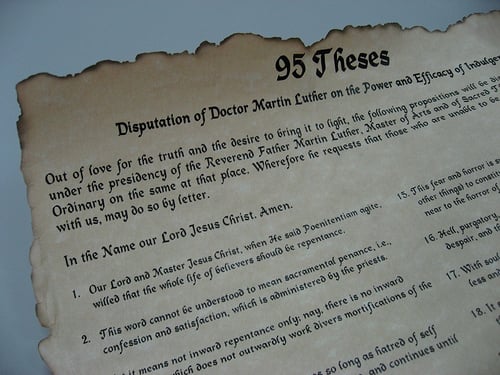
Reforming the church

Some parts of the modern-day church are called “Reformed.” One may wonder why. Should the church need reforming? May she have gone off course? Is she infallibly held in the truth or may she become corrupted? If so, what authority is competent to reform her? Is it even thinkable that anyone may be able to reform the church? The church is a global phenomenon of believers in Jesus, divided into innumerable groups, some large, some small. It is so huge that no-one can grasp the whole with a view to reforming it, not even the Pope.

So while some want a progressive or reforming Pope and others insist on a traditional Pope, there are already two dividing tendencies within the Roman Church, quite apart from the many other kinds of churches. And if one wants to “reform” the church, by what criteria might it be reformed?

The 16th century saw what came to be called “the Reformation”. The moral quality of the church and its leadership had suffered a sad decline over the previous century. Even Roman Catholic historians admit the immoral behaviour of some Popes left a lot to be desired. Their conduct was unworthy of the Lord Jesus Christ whom they professed to serve.

Apart from that moral decline, the reformers discerned theological errors that had been adopted in the church’s teaching and practice. How did they know there were errors? By a return to studying the Bible.

Martin Luther was a monk whose task was to teach theology. He therefore studied the Scriptures that he had to teach. As he did so, he struggled to understand some key concepts that were fundamental to the Gospel message, notably those of righteousness and justification. He had his own personal struggle to become righteous, being very conscious of his inner faults, spending a lot of time in confession. He was at the same time puzzling over St Paul’s teaching on the theme of justification, notably in the epistle to the Romans chapters 1-5.

After a lot of soul-searching and Bible study, he finally found the key that he had never grasped before: how God “justified” (i.e. declared legally just and acceptable in the judgment) those who believe in Jesus, the Saviour who died and rose again for their salvation. None of his confessors or colleagues at university had been able to share this good news with him, for they neither taught it nor understood it themselves. But there it was in the New Testament!

It was this rediscovery of the Bible’s message of “justification by faith in Christ” that led to the reformation and birthed the “reformed church”. While official church leaders condemned Luther, many were glad to receive the message of salvation by faith in Christ. They studied the Bible to find the truth of God, and by that truth they sought to reform the church’s moral laxity and its inadequate teaching on justification.

When challenged as to why they held their doctrines, their answer was simply, “Because the Bible says so.” The Bible was henceforth to be the sole authority to which Christians should absolutely adhere. In any dispute, the way to resolve it was always by a return to studying what the Bible actually says. This remains the principle of the reformed church.

Unfortunately, the temptation to allow passing philosophical trends to influence theologians has led parts of the church to drift from biblical faithfulness. Wisely did the Reformers insist that the church should be “semper reformanda” – continuously reforming itself by Holy Scripture, maintaining the purity of both its holiness and its biblical doctrine.

Clive Every-Clayton
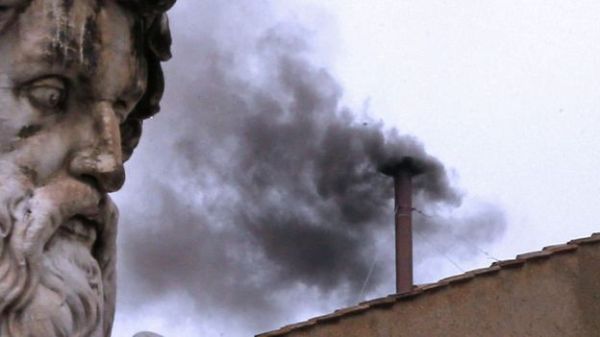
The Pope

The death of Pope Francis reminds me of the time some years back when a different conclave was about to choose a new pope. I thought it would be pertinent to write an article about whether it was really Jesus’ desire that his church be governed by a “pope”. So I wrote, (in French as I was living in Belgium at the time), a full page article that I sent to La Libre Belgique, which they published the day after Cardinal Ratzinger became Pope Benedict. However, they chose for my article a title which I had not proposed at all, though my feeling was not betrayed by it: “Jesus didn’t want a Pope”.

I have several reasons for thinking that the Roman Catholic version of Christianity is not the best, and I have written a booklet (again, in French) on the differences between Catholics and Protestants. The most essential difference is the source of authority for what the church teaches. 

Obviously, the teachings of Jesus are central for all Christians and they are consigned in the four biblical gospels: Matthew and John (two of Jesus’ twelve apostles) and Mark who according to ancient tradition received his details from the apostle Peter, and Luke a medical doctor who did serious research to set forth his account.

It was Jesus’ apostles who also wrote the other documents that the early church’s discernment considered authoritative when they decided which books to include in the New Testament. From the beginning therefore the New Testament was treated – like the Old Testament had been by the Jews – as being writings inspired by God’s Spirit: the Bible was the essential trustworthy source of revealed truth. 

Since the fourth century AD ecumenical councils met to define Christian doctrines that were contested by some who called themselves Christians. The teaching decided by these councils was to be universally accepted as defining church doctrine. Church Traditions enshrining such dogmas thus came progressively to be considered authoritative, alongside the Bible. Among these traditions was a particular meaning given to Jesus’ words to the apostle Peter, “You are Peter, and on this rock I will build my church” (Matthew 16.18), and his charge to Peter to “feed my sheep” (John 21.17).  These verses were taken to mean that the apostle Peter was established by Christ as universal leader, Bishop or “Pope” over the worldwide church. Then, since Peter had been martyred at Rome, the successive bishops of the church of Rome were to be considered the “successors of Peter”. Church dogma on this culminated in the Vatican Council of 1870 when papal infallibility was defined as a Catholic doctrine.

In this way, with the passing of the centuries, Christian teaching was practically fashioned more by human Tradition than by authoritative Scripture. My article in La Libre Belgique raised the question as to whether the Catholic interpretation of those words of Jesus justified the total dominance of the Pope’s teaching authority, especially since the protestant reformers, for whom “the Bible alone” was divinely authoritative, questioned and relativised church tradition.

The Reformers started translating and distributing the Bible, as they were convinced that it was the supreme source of Christian teaching, the ultimate inspired Word of God by which all human teaching or tradition should be tested.

The fundamental difference therefore between Catholics and Protestants is this question of the source of authority for church teaching. What should have the last word for establishing Christian doctrine? For Catholics it is the Bible plus Church Tradition and the official declarations of the infallible Popes. For Protestants, it is the Bible alone.

Clive Every-Clayton

Blog at WordPress.com.

Up ↑